Showing posts with label public domain pick of the week. Show all posts

Tuesday, November 16, 2010

Public Domain Pick of the Week: Haxan


This week's pick is the 1922 Swedish/Danish co-production Haxan or Witchcraft through the Ages. This is the original longer version without the William S. Burroughs narration or the free jazz soundtrack. Instead, the soundtrack is early 20th century recordings of Beethoven, Tchaikovsky, Schubert, and others. I like the way it sounds so much I just play the movie in a separate window while I'm working to listen to the music.

If you've never seen it, it's an exposition of beliefs about witches in medieval and early modern Europe (including lots of recreations) that ends with a coda about the rationalization of witchcraft beliefs into modern concepts about mental illness.

You can watch this entire brilliant Swedish movie online here.

Sunday, May 23, 2010

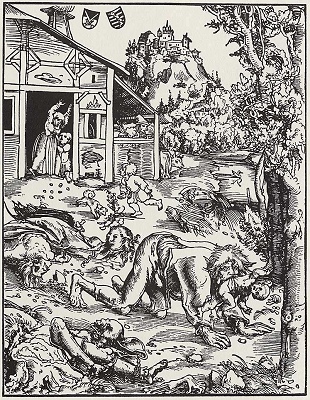
Public Domain pick of the week: Robert Eisler's Man into Wolf


The best thing about Archive.org is the quantity streaming Dead and Ween shows.

But the amount of free public domains available for free as pdfs and even Kindle-ready e-books is a close second.

This week's pick is Man into Wolf, which you can get here.

In Ann Arbor a few years ago I stumbled across a work with the rather sensational title Man into Wolf: An Anthropological Interpretation of Sadism, Masochism and Lycanthropy.

The book, consisting of a 30-page essay followed by 249 pages of notes and appendices, was written by Jungian historian of religion and art Robert Eisler after he spent fifteen months imprisoned in Buchenwald and Dachau.

In it, Eisler, whose earlier work was on Jamesian Christianity, argues that a group of wolf-men began imitating wild predators in response to food shortages during the Ice Age. Subsequently they broke off from the pacific vegetarian proto-human family and their archetypal pack mentality, he argues, is present in the psychology of both sexual sadists and violent oppressors like Hitler.

For his evidence Eisler uses everything from the writings of Sade to European folklore to recorded dreams. The book's reception was mixed. One reviewer wrote, "The main value of this publication is in the valuable source material which might be used by future scientists."

Another commented, "In spite of the oddity of the argument, the book is plainly the product of a man of brilliant, if erratic, intelligence and strong character."
Eisler’s text is a failure as a work of anthropology or theory of religion, but is a genre-blurring mixture of scholarship, autobiography and memorial to trauma that has a lot to teach us.